Table of Contents
ToggleTiny house kits have exploded in popularity as housing costs continue to climb. What started as a fringe movement has become a practical solution for backyard offices, rental units, guest houses, and even primary residences. Amazon now stocks dozens of prefab and DIY tiny house kits under $5000, ranging from bare-bones shell kits to semi-finished studio structures. But before clicking “Add to Cart,” buyers need to understand what these kits actually deliver, and what they don’t. Most require significant additional work, materials, and often permits.
Key Takeaways
- Amazon tiny house kits under $5000 are available in three categories—shell kits, prefab studios, and panel systems—but none include foundations, electrical, or plumbing, requiring significant additional investment and work.
- Most buyers spend $2,000–$4,000 on add-ons like insulation, electrical systems, and interior finishes, bringing total project costs to $5,500–$7,500 well beyond the kit price.
- Prefab studio kits (Allwood Solvalla, Lillevilla Getaway) arrive as large panels and assemble in a weekend, while shell kits demand intermediate carpentry skills, multiple helpers, and 3–4 days of work.
- Permits are almost always required for structures over 120 square feet with electrical and plumbing, and zoning restrictions including setbacks, lot coverage limits, and HOA covenants must be verified before purchase.
- Site preparation, delivery logistics (including liftgate and forklift costs), tool rentals, and weather delays add hidden expenses that first-time builders often underestimate.
- Tiny house kits work best for backyard offices, guest houses, and seasonal cabins—not primary residences—and require permanent or semi-permanent foundations like concrete piers rated for 3,000–5,000 lbs.
What Are Tiny House Kits and Why Buy on Amazon?
A tiny house kit is a prefabricated package containing the structural components needed to assemble a small dwelling, typically ranging from 80 to 400 square feet. Unlike traditional construction, these kits arrive with pre-cut framing, wall panels, or modular sections designed for faster assembly.
Amazon’s appeal as a marketplace for tiny house kits comes down to logistics and buyer protection. Prime shipping can deliver a 10′ x 12′ cabin shell to your driveway in days, and Amazon’s A-to-Z Guarantee offers recourse if components arrive damaged or incomplete. Third-party sellers list everything from basic timber frame kits to insulated panel systems, often at prices $1000-$3000 below what specialized tiny home retailers charge.
Most Amazon kits fall into three categories: shell kits (framing and exterior sheathing only), prefab studios (walls, roof, and floor assembled), and panel systems (insulated structural panels requiring minimal framing). None include foundations, and most stop short of electrical, plumbing, or interior finishes. Buyers should treat these as raw building platforms, not move-in-ready homes.
These kits work best for accessory dwelling units (ADUs), backyard offices, workshops, or seasonal cabins. Anyone considering one as a primary residence needs to verify local building codes permit structures under 400 square feet and whether the kit meets IRC (International Residential Code) standards for habitable space.
Top-Rated Amazon Tiny House Kits Under $5000
Prefab Studio Kits ($3000-$5000)
Prefab studios arrive as large panels or modular sections. The Allwood Solvalla Studio Kit ($4,200-$4,800) includes Nordic spruce wall panels, double-glazed windows, a solid wood door, and a 117 sq ft footprint. Assembly typically takes two people a weekend. Walls are 19mm (3/4″) thick, adequate for three-season use in mild climates but requiring additional insulation for year-round occupancy in cold zones.
Another option is the Lillevilla Getaway cabin kit ($4,500-$5,000), offering 113 sq ft with 28mm (1-1/8″) interlocking log walls. Thicker walls provide better thermal mass, but the kit still lacks insulation, electrical rough-in, or flooring beyond structural decking. Expect to add $1,500-$2,500 for insulation, wiring, and finished floors.
These prefab studios suit buyers who want faster assembly and a semi-finished exterior. They work well as backyard guest houses where utilities can be extended from the main dwelling. But, they’re not truly “tiny houses on wheels”, these require permanent or semi-permanent foundations like concrete piers, gravel pads, or deck blocks rated for the structure’s weight (typically 3,000-5,000 lbs fully loaded).
DIY Cabin Shell Kits ($2000-$4000)
Shell kits provide framing lumber, sheathing, and basic roofing materials. The Summerwood Cabana Kit (around $3,200) includes pre-cut 2×4 framing for an 8′ x 10′ structure, OSB sheathing, asphalt shingles, and assembly hardware. Buyers supply the foundation, windows, door, insulation, and all interior finishes.
Budget-focused builders often turn to bare-bones timber frame kits like those from Caribbean Blinds & Sheds ($2,000-$3,500 for 10′ x 12′ shells). These include dimensional lumber cut to length and basic fasteners. Assembly requires intermediate carpentry skills, a circular saw or miter saw, a drill, a level, and at least one helper. Plan on 3-4 full days for framing and sheathing.
Shell kits offer maximum customization. Builders can choose their own window placements, door styles, and interior layouts. They’re ideal for anyone comfortable with framing and who wants to source their own insulation, siding, and finishes. For detailed framing techniques, Ana White’s building guides provide free plans compatible with these shell kit dimensions.
What’s Included vs. What You’ll Need to Add
Typical kit contents:
- Pre-cut framing lumber or wall panels
- Roof trusses or rafters
- Exterior sheathing (OSB or plywood)
- Roofing material (usually asphalt shingles or metal panels)
- Windows and door(s) (in prefab kits: rarely in shell kits)
- Assembly hardware (bolts, brackets, screws)
- Instruction manual (quality varies widely)
What you’ll always need to add:
- Foundation: Concrete piers, gravel pad, or treated timber skids. Budget $300-$800 for a simple pier foundation sized for 100-150 sq ft.
- Insulation: Fiberglass batts (R-13 to R-19 for walls, R-30 to R-38 for roof) cost $0.50-$1.20 per sq ft. Spray foam costs more but seals gaps better.
- Electrical: Wire, outlets, light fixtures, and breaker panel connection. If extending from an existing structure, budget $400-$1,000 for materials and permit fees. Hire a licensed electrician if you’re unfamiliar with NEC requirements.
- Plumbing: PEX tubing, fixtures, and drain lines. A basic sink and toilet setup runs $300-$600 in materials, but code-compliant waste lines require knowledge of venting and slope.
- Interior finishes: Drywall or tongue-and-groove paneling, flooring (vinyl plank, laminate, or engineered wood), paint or stain.
- HVAC: A mini-split heat pump ($600-$1,200) works well for spaces under 200 sq ft. Window AC units and electric baseboard heaters are cheaper but less efficient.
Most buyers spend $2,000-$4,000 on add-ons and finishes for a $3,500 kit, bringing total project costs to $5,500-$7,500. For those who want step-by-step installation help, The Handyman’s Daughter offers tutorials on framing, insulating, and finishing small structures.
Installation Tips and Hidden Costs to Consider
Site prep is non-negotiable. Clear vegetation, level the ground, and compact the soil or lay a gravel base before the kit arrives. A 10′ x 12′ structure needs a foundation footprint of at least 11′ x 13′ to allow for overhangs and drainage. Rent a plate compactor ($70/day) or hire an excavator ($300-$600) if the site slopes more than 6 inches across the footprint.
Delivery logistics: Amazon typically ships kits via freight carrier on a pallet or crate. Curbside delivery is standard: liftgate service costs extra ($75-$150). If your property lacks driveway access, budget for a forklift rental ($150-$250/day) or plan to hand-carry materials. A 10′ x 12′ shell kit weighs 1,500-2,500 lbs across multiple packages.
Tool requirements: Most prefab kits need only basic tools, drill, level, ladder, tape measure, and socket set. Shell kits require a circular saw, speed square, chalk line, and framing nailer (or hammer and galvanized nails). Rent specialty tools like a framing nailer ($40/day) rather than buying if it’s a one-time project.
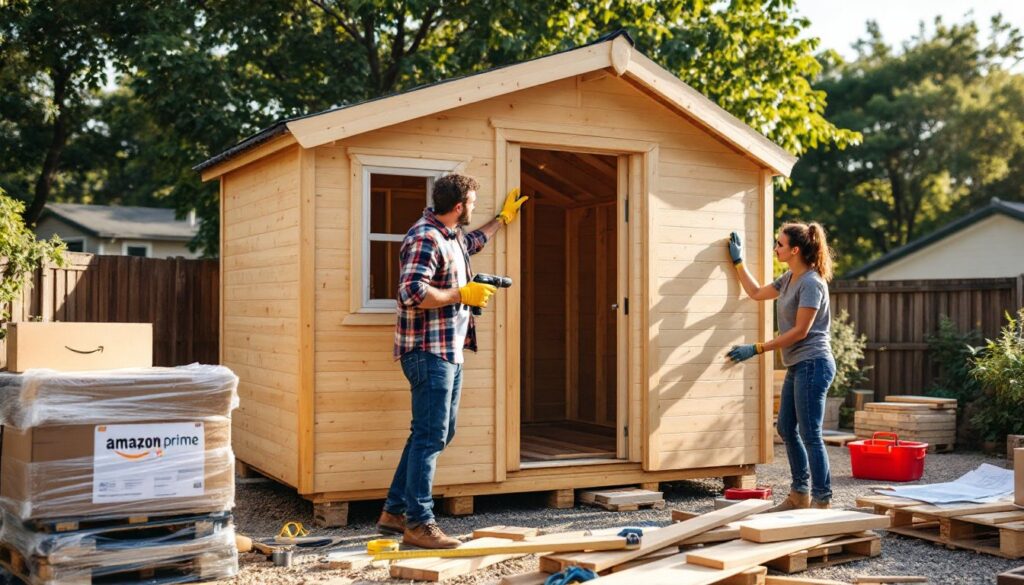
Two-person minimum: Even “easy assembly” kits require a helper for lifting wall panels, holding framing square, and positioning roof trusses. Prefab studios with 8-foot wall panels are manageable for two adults: shell kits with loose lumber often need three people during roof framing.
Hidden costs to watch:
- Permits: $200-$1,500 depending on jurisdiction (see next section)
- Fasteners and sealants: Kits rarely include enough. Budget $50-$150 for extra screws, construction adhesive, and caulk.
- Window and door trim: Not included in most shell kits. Add $100-$200 for exterior trim boards.
- Paint or stain: Exterior protection is essential. A gallon of solid stain ($30-$50) covers 200-350 sq ft depending on surface texture.
- Utility hookups: Extending water, sewer, and electric from an existing structure costs $500-$2,000 in materials and labor.
Weather delays: Plan for at least two dry weekends to complete assembly and make the structure weathertight. Wet OSB sheathing swells and delaminates: cover materials immediately if rain threatens.
Legal and Zoning Considerations Before You Buy
Permits are almost always required for structures over 120 sq ft or those with electrical and plumbing systems. Accessory structures under 200 sq ft sometimes qualify for simplified permits, but this varies by county and municipality. Call your local building department before purchasing a kit.
Zoning restrictions to check:
- Setbacks: Most jurisdictions require 5-10 feet between accessory structures and property lines. Corner lots often have stricter rules.
- Lot coverage limits: Total building footprint (main house + outbuildings) can’t exceed 30-50% of lot area in many residential zones.
- ADU regulations: If the tiny house will have a kitchen and bathroom, it may be classified as an accessory dwelling unit. ADUs often require separate utility meters, impact fees, and parking spaces.
- HOA covenants: Homeowners associations frequently prohibit outbuildings or require architectural review before construction.
Foundation and permanence: Structures on permanent foundations (concrete slabs, frost footings) trigger stricter code requirements than those on skids or piers. Some jurisdictions consider anything anchored to the ground a permanent structure requiring full building permits and inspections.
Electrical and plumbing inspections: Any work involving household circuits or potable water needs inspection by a certified inspector. Failing to pull permits risks fines, forced removal, or complications when selling the property.
Tiny houses on wheels (THOW): If you’re considering a kit for a mobile tiny house, check local RV and trailer regulations. Most areas prohibit living in RVs on residential lots for extended periods. THOW classified as recreational vehicles must meet RVIA standards, which Amazon kits typically don’t.
Insurance considerations: Standard homeowners policies may not cover unpermitted structures. Notify your insurer before construction to avoid claim denials. Some insurers require a certificate of occupancy for accessory buildings over $5,000 in value.
For ideas on how tiny structures can generate rental income, explore creative small-space living strategies that align with local short-term rental ordinances. Always consult a local contractor or architect familiar with regional codes before committing to a kit purchase.