Table of Contents
ToggleFinding a builder for a two-bedroom tiny house isn’t like hiring someone to add a deck. You’re investing in a dwelling that must balance space efficiency, code compliance, and livability, all within 400-600 square feet. The wrong builder can leave you with inadequate storage, poor ventilation, or worse, a structure that doesn’t meet local zoning requirements. This guide walks through the key builders, decision points, and questions that separate a well-executed tiny home from an expensive mistake.
Key Takeaways
- Two-bedroom tiny house builders offer essential expertise in balancing space efficiency, code compliance, and livability within 400-600 square feet, preventing costly mistakes.
- The right 2 bedroom tiny house builder should be certified, insured (minimum $1 million general liability), and clear on which code standard they follow—IRC Appendix Q, RVIA, or local residential code.
- Professional two-bedroom tiny house construction costs $50,000–$150,000 depending on finishes and whether it’s on wheels or a foundation, with typical timelines of 8–16 weeks for prefab and 6–12 months for custom builds.
- Always review a builder’s past projects in person, verify weight distribution and load calculations, and obtain detailed payment schedules (typically 10–20% deposit, 40% at framing, 40% at substantial completion).
- Ask potential builders upfront what’s included in the final price—appliances, off-grid systems, delivery, and window treatments—to avoid surprise costs and change order fees.
Why Choose a 2 Bedroom Tiny House?
A two-bedroom configuration solves the biggest complaint about tiny living: lack of privacy. Single-room layouts work for solo dwellers, but couples with a home office, parents with one child, or anyone hosting occasional guests need separation.
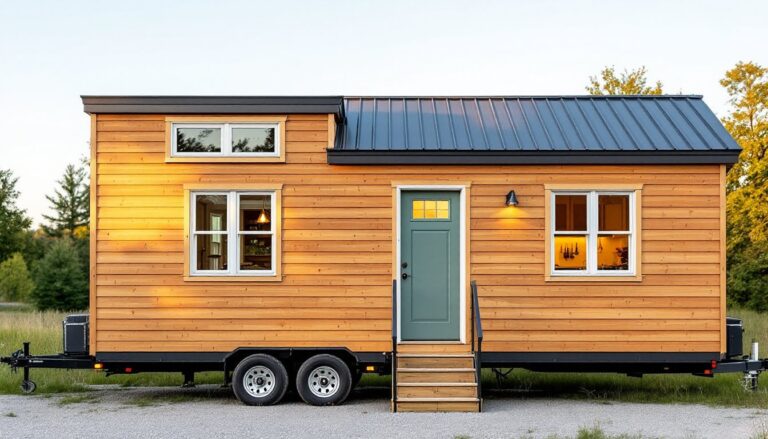
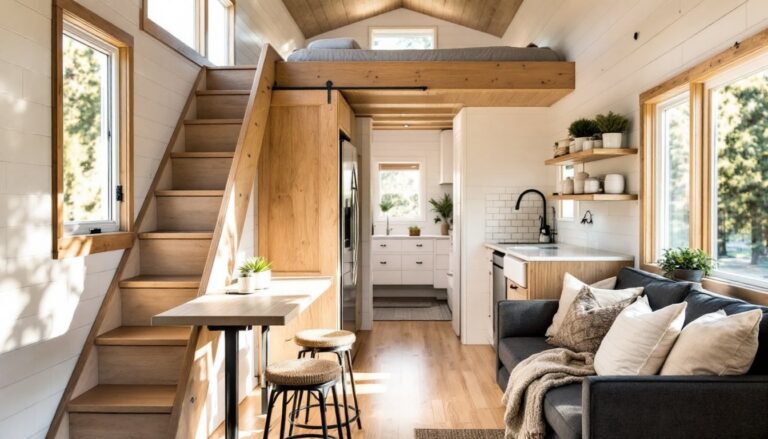
Most two-bedroom tiny houses range from 400-600 square feet. That’s tight, but doable with smart design: lofted bedrooms (typically 6-7 feet of headroom), Murphy beds, or convertible spaces. One bedroom usually sits in a ground-floor nook (8×10 feet is common), while the second goes in a loft accessed by ladder or stairs.
The layout affects trailer requirements. A 30-foot trailer can accommodate a two-bedroom floor plan, but you’ll need a gooseneck or fifth-wheel hitch for anything over 13.5 feet tall to meet DOT height limits. If you’re building on a foundation, check local IRC minimums, some jurisdictions require at least 120 square feet per habitable room.
Two-bedroom designs also appeal to municipalities easing ADU (accessory dwelling unit) restrictions. Portland, Austin, and Los Angeles have streamlined permits for structures under 800 square feet, and a compact two-bedroom fits that cap while offering rental or multigenerational housing potential.
Top 2 Bedroom Tiny House Builders to Consider
Choosing a builder means evaluating track record, customization options, and whether they handle permitting. Here are standout names in 2026:
Tumbleweed Tiny House Company has been in the game since 1999. They offer both DIY shell kits and turnkey builds. Their Cypress model (two bedrooms, 26 feet long) includes pre-wired electrical and plumbing rough-ins. Expect $70,000-$95,000 depending on finishes.
New Frontier Tiny Homes specializes in RVIA-certified models, meaning they meet RV standards for electrical and LP systems. Their Alpha model sleeps four across two lofts and a convertible living area. RVIA certification simplifies financing and insurance but limits customization, outlets, for example, must meet NEC Article 551 for RVs, not residential code.
Tiny Heirloom caters to the high-end market. Their builds feature hardwood cabinetry, tankless water heaters, and full-size appliances. A two-bedroom model starts around $150,000, but finishes rival conventional homes. They also coordinate zoning and foundation work if you’re placing the unit permanently.
Rocky Mountain Tiny Houses offers semi-custom builds. You pick a base floor plan, then modify window placement, loft height, and interior finishes. Turnaround is 4-6 months, and they provide detailed weight calculations, critical if you’re towing.
For a more budget-conscious route, Jamaica Cottage Shop sells shell kits with pre-cut framing and exterior sheathing. You handle insulation, drywall, and mechanicals. A 16×30-foot shell runs about $25,000, but factor in another $30,000-$50,000 for finish work if you’re hiring out.
Custom vs. Prefab Builders: What’s the Difference?
Prefab builders manufacture standardized floor plans in a controlled environment, then deliver the completed unit. Think New Frontier or Tumbleweed’s catalog models. Benefits: faster turnaround (8-16 weeks), predictable pricing, and factory-grade moisture control. Drawbacks: limited layout changes and finishes locked to the builder’s supply chain.
Custom builders like Tiny Heirloom or local contractors work from your specs. You dictate ceiling height, window brands, even stud spacing (16-inch vs. 24-inch on-center affects insulation and load capacity). Custom builds take 6-12 months and cost 20-40% more, but you get exactly what you need, say, a wheelchair-accessible bathroom or a composting toilet setup.
One hybrid option gaining traction: modular prefab construction blends factory efficiency with some customization. Modules are built to your square footage and mechanical specs, then assembled on-site. It’s faster than stick-built, more flexible than pure prefab.
How to Choose the Right Tiny House Builder for Your Needs
Start with certification and insurance. Ask if the builder carries general liability (minimum $1 million) and workers’ comp. If they’re building an RVIA-certified RV, verify credentials through the RV Industry Association. For foundation builds, confirm they’re licensed contractors in your state.
Next, clarify code compliance. Tiny houses on wheels often fall into a gray area, too large for RVs, too mobile for residential code. Some builders design to IRC Appendix Q (tiny house standards adopted by some states), others to ANSI A119.5 (park model RV standard). If you’re financing or insuring the build, lenders typically require one or the other.
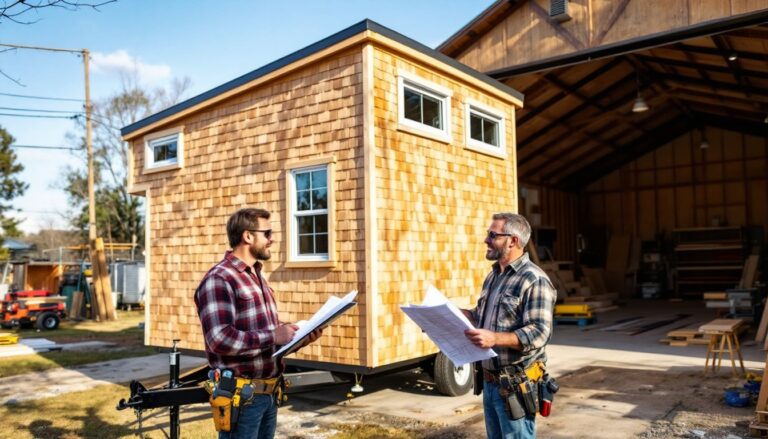
Review past projects in person if possible. Photos hide details like cabinet joinery, flashing around windows, and how well trim meets drywall. Check for straight walls (use a 4-foot level), smooth door operation, and whether outlets are GFCI-protected near sinks (NEC 210.8 requirement).
Ask about weight distribution. A poorly balanced trailer will fishtail at highway speeds. Reputable builders provide a weight breakdown: tongue weight (10-15% of total), axle load, and GVWR (gross vehicle weight rating). If the finished house exceeds the trailer’s capacity, you’re looking at frame damage or worse.
Finally, nail down what’s included. Does the price cover appliances? Window treatments? Off-grid systems like solar panels or composting toilets? Some builders quote a base shell, then charge $15,000-$30,000 for finish packages. Get it in writing.
What to Expect: Cost Breakdown and Timeline
A professionally built two-bedroom tiny house runs $50,000-$150,000 depending on size, finishes, and whether it’s on wheels or a foundation. Here’s how costs typically break down:
- Trailer or foundation: $5,000-$15,000. A dual-axle 30-foot trailer rated for 14,000 lbs costs around $7,000. A pier-and-beam foundation for a stationary build runs $8,000-$12,000.
- Shell and framing: $15,000-$25,000. Includes 2×4 or 2×6 wall framing, subfloor (¾-inch tongue-and-groove plywood), roof trusses, and exterior sheathing.
- Windows and doors: $3,000-$6,000. Tiny houses need energy-efficient windows (U-factor 0.30 or lower) to offset limited insulation depth. Andersen or Pella vinyl-clad units fit most budgets.
- Mechanical systems: $8,000-$15,000. Includes a mini-split HVAC (12,000 BTU handles 400-600 sq ft), 50-gallon electric or tankless water heater, PEX plumbing, and Romex wiring to code.
- Interior finishes: $10,000-$30,000. Cabinetry, countertops (butcher block or quartz), flooring (luxury vinyl plank is durable and light), drywall, and paint.
- Appliances and fixtures: $5,000-$10,000. Apartment-size fridge, two-burner cooktop, combo washer-dryer, and bathroom fixtures.
Timeline: Prefab builds take 8-16 weeks from deposit to delivery. Custom builds run 6-12 months, longer if you’re securing permits or dealing with weather delays. Foundation pours need 28 days to cure before framing starts, and inspections can add 2-4 weeks depending on your municipality’s workload.
Financing is tricky. Traditional mortgages don’t cover tiny houses on wheels. You’ll need an RV loan (if RVIA-certified), a personal loan (rates typically 7-12%), or a construction loan for foundation builds. Credit unions often have better terms than big banks.
Essential Questions to Ask Before Hiring a Builder
Before signing a contract, pin down these specifics:
-
What code or standard are you building to? IRC Appendix Q, RVIA, ANSI A119.5, or local residential code? This affects resale, insurance, and where you can legally park or place the home.
-
Who pulls permits and schedules inspections? Some builders handle this: others expect you to coordinate with your local building department. Permitting for a foundation tiny house can take 4-12 weeks.
-
What’s the warranty? Look for at least one year on labor and materials. Structural components (frame, roof) should have longer coverage. Ask what’s excluded, often appliances and owner-caused damage.
-
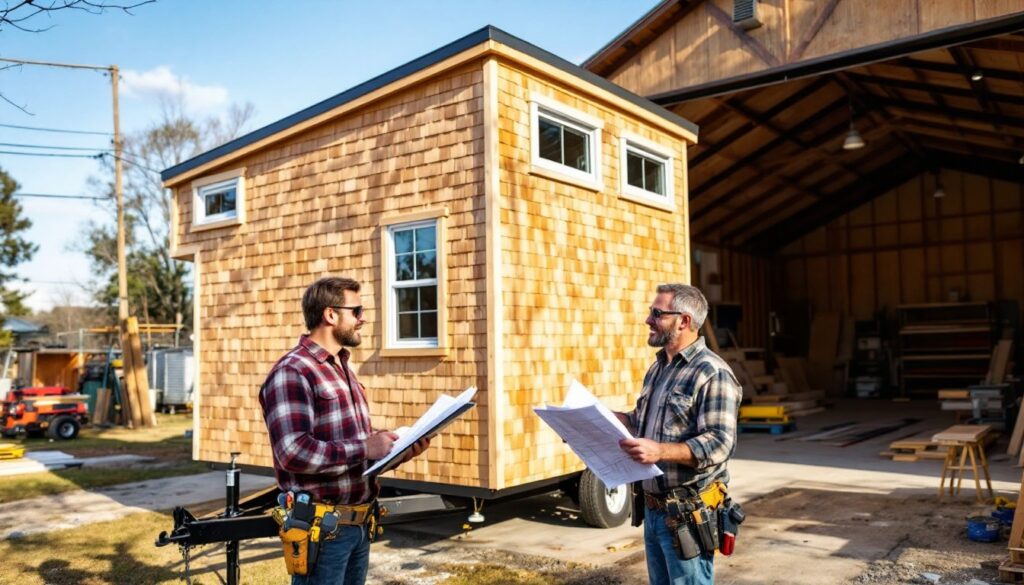
Can I see the build in progress? Reputable builders welcome site visits. If they’re evasive, that’s a red flag. You want to verify proper flashing, vapor barriers, and insulation installation before walls close up.
-
What’s the payment schedule? Typical: 10-20% deposit, 40% at framing completion, 40% at substantial completion, 10% at final walkthrough. Never pay the full amount upfront.
-
How do you handle change orders? Swapping a window size or adding outlets mid-build costs extra. Get a written per-item fee schedule.
-
What’s included in delivery? For wheeled tiny houses, does the builder tow it to your site, or do you arrange transport? Professional towing runs $3-$5 per mile for houses over 10,000 lbs.
-
Do you offer off-grid packages? If you’re placing the house on rural land, you may need solar panels (4-6 kW system for two bedrooms), a composting toilet, and a greywater system. Some builders partner with specialists: others leave it to you.
Also ask for references, and actually call them. Find out if the builder stayed on schedule, handled issues professionally, and delivered quality work. Bonus if you can tour one of their completed projects. Many strategies for reducing housing costs, like those seen in house hacking examples, apply well to tiny house living when you’re offsetting costs through rentals or reduced utility bills.
Conclusion
A two-bedroom tiny house is a real solution for affordable, flexible living, but only if the builder knows load calculations, code nuances, and how to make 500 square feet functional. Do the assignments: verify credentials, review contracts, and don’t skip the in-person walkthrough. The right builder delivers a home that’s both livable and compliant, whether you’re downsizing, adding an ADU, or hitting the road.