Table of Contents
ToggleBuilding an ADU tiny house on your property isn’t just trendy, it’s a practical solution to housing shortages, multigenerational living, and generating rental income. These compact structures combine the efficiency of tiny house design with the permanence of an accessory dwelling unit, offering everything from guest quarters to a full-time residence in 400-800 square feet. Whether you’re planning to house aging parents, create a home office, or tap into your property’s earning potential, understanding the costs, codes, and construction options upfront will save you headaches down the road.
Key Takeaways
- An ADU tiny house is a permanent, code-compliant secondary dwelling unit that blends tiny house efficiency with foundation-based permanence, generating $1,200-$3,000+ in monthly rental income while increasing property value by 20-35%.
- ADU tiny house projects typically cost $120,000-$250,000 ($200-$400 per square foot), with financing options including home equity loans, HELOCs, and ADU-specific lending products that factor in projected rental income.
- Zoning laws vary significantly by location; check your local planning department for lot size minimums, maximum ADU square footage, setback requirements, and owner-occupancy mandates before committing to a design.
- Prefab ADUs install faster (1-2 days) at $150-$300 per square foot but require crane access and offer limited customization, while site-built ADUs provide full design control and potential for DIY finishing work over 6-12 months.
- Foundation costs, utility connections ($10,000-$25,000), permits, and professional licensing for electrical and plumbing work are non-negotiable expenses; proper planning upfront prevents code failures and costly delays.
- ADU tiny houses work well for multigenerational living, rental income, guest quarters, or home offices and complete construction 3-6 times faster than traditional home additions.
What Is an ADU Tiny House?
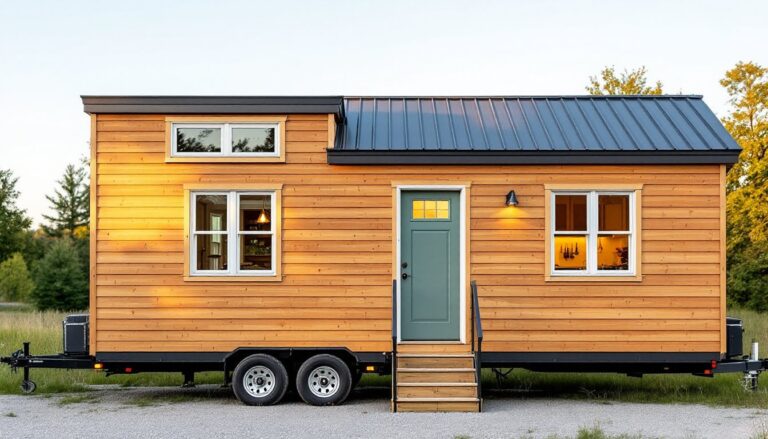
An ADU (Accessory Dwelling Unit) is a secondary residential structure on a single-family lot, while a tiny house typically refers to a dwelling under 400 square feet, often on wheels. An ADU tiny house blends both concepts, a small, permanent structure built on a foundation that complies with local building codes.
Unlike RVs or mobile tiny homes, ADU tiny houses connect to permanent utilities (water, sewer, electric) and must meet the same structural, electrical, and plumbing codes as your main house. Most fall between 400-800 square feet, which is larger than the classic tiny house movement’s footprint but still compact enough to maximize yard space.
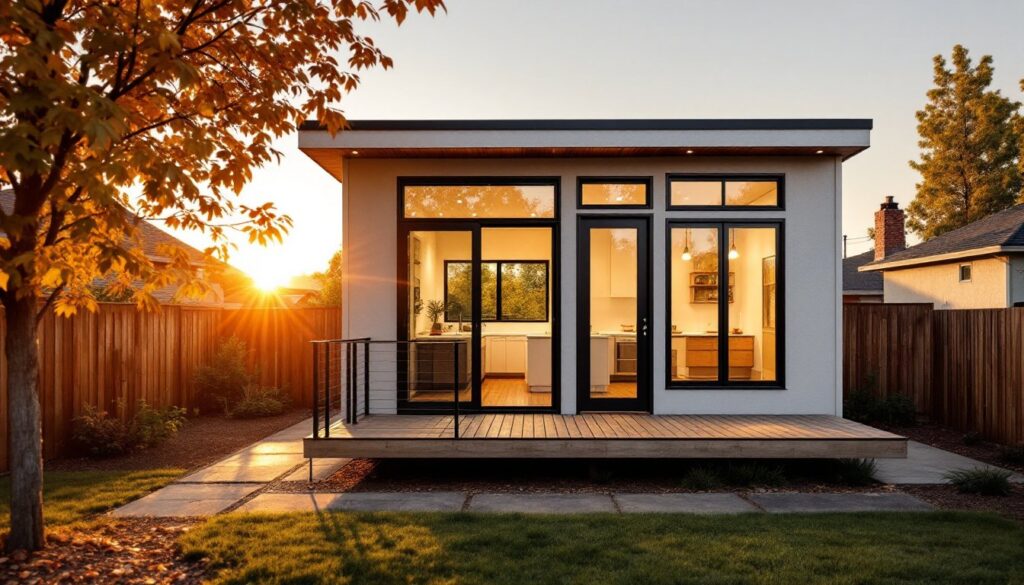
These units come in three main forms: detached (standalone structure), attached (connected to the main house), or garage conversion. Detached ADUs offer the most privacy and are the most common choice for tiny house designs. They require separate foundations, typically a concrete slab or crawlspace, and must meet setback requirements from property lines.
Benefits of Building an ADU Tiny House on Your Property
Rental income is the top driver for most homeowners. Depending on your market, a well-built ADU can generate $1,200-$3,000+ monthly. In high-demand urban areas, that income can cover your mortgage or fund other projects.
Multigenerational living is another major benefit. An ADU tiny house gives aging parents independence while keeping them close for daily support. It also works for adult children transitioning to independence or as a caregiver’s quarters.
ADUs increase property value, studies show homes with permitted ADUs sell for 20-35% more than comparable properties. Buyers see the flexibility: rental potential, guest space, or a home office that’s actually separate from the main house.
From a design perspective, small-footprint living pushes efficiency. Every square foot counts, which forces smart storage, multi-use furniture, and thoughtful layouts. Many homeowners find that living or hosting in a well-designed small space teaches them what they actually need versus what they’ve been storing out of habit.
Finally, ADU tiny houses offer faster construction timelines than full home additions. A prefab unit can be move-in ready in 3-6 months: a custom build typically takes 6-12 months, compared to 12-18+ for major home additions.
ADU Tiny House Design Options and Floor Plans
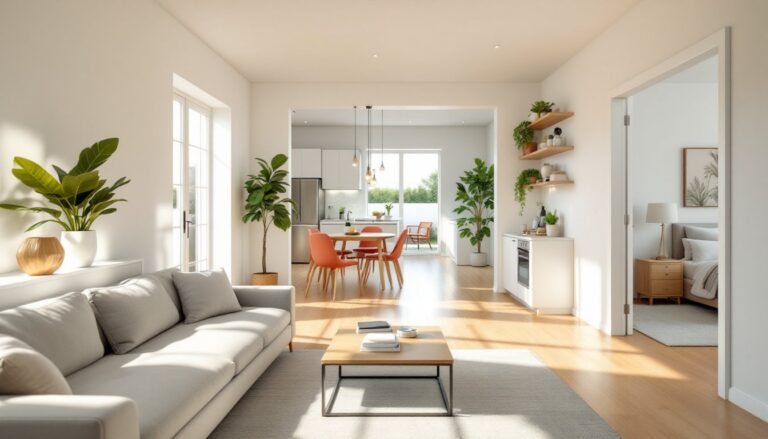
Studio layouts (400-500 sq ft) are the most cost-effective. They feature an open-plan living/sleeping area, a compact kitchen (often a galley or single-wall layout), and a full bathroom. These work well for single occupants or couples and keep construction costs down by minimizing interior walls and plumbing runs.
One-bedroom designs (500-650 sq ft) add a separate bedroom, which increases rental appeal and privacy. The bedroom usually sits at one end, with the kitchen and living area at the other. Expect to add $15,000-$25,000 to your build cost for the extra square footage and interior framing.
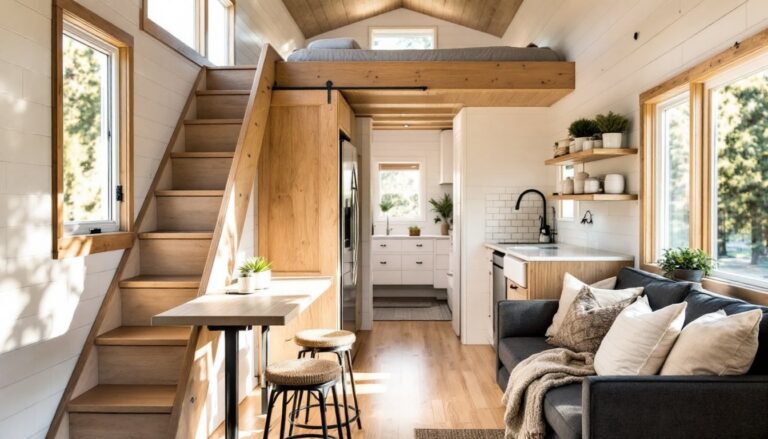
Loft designs maximize vertical space by placing the bedroom on a second-floor loft accessed by a ladder or compact staircase. This keeps the footprint small while creating distinct living zones. Lofts require 9-10 ft minimum ceiling height in the main floor to allow headroom upstairs, check local IRC height requirements, which typically mandate 7.5 ft ceilings in habitable spaces.
Bathroom placement matters. Grouping plumbing on one exterior wall simplifies utility runs and reduces costs. A 3×5 ft bathroom is the minimum for a toilet, sink, and shower: 5×7 ft allows a small tub. Use pocket doors to save swing space.
Kitchen options range from a mini galley (6-8 linear feet) with apartment-size appliances to a full kitchen with standard 24-inch-deep base cabinets. If the ADU will be rented, local codes may require a full-size refrigerator and stove.
Many urban living guides emphasize outdoor connections, French doors, large windows, or a covered porch, to make small interiors feel larger. A 6×8 ft deck adds usable square footage without increasing the building footprint or permit complexity.
Costs and Financing Your ADU Tiny House Project
Expect to spend $120,000-$250,000 for a turnkey ADU tiny house, or roughly $200-$400 per square foot, depending on finishes, location, and whether you hire a general contractor or act as your own GC.
Foundation costs run $8,000-$15,000 for a concrete slab (most common for ADUs) or $12,000-$20,000 for a crawlspace foundation. Pier-and-beam foundations can work on sloped lots but add engineering costs.
Utility connections, sewer, water, gas, electric, typically cost $10,000-$25,000. If your main house is far from the street or you need a new electrical panel upgrade to handle the load, costs climb. Budget for a 100-amp subpanel at minimum: 200-amp is better if you’re adding HVAC and electric appliances.
Permit and design fees vary wildly. Plan checks, building permits, and impact fees can range from $2,000 in rural areas to $25,000+ in cities with strict ADU regulations. Architectural plans run $3,000-$8,000 for stock plans, $8,000-$15,000 for custom.
Financing options include home equity loans, HELOCs, cash-out refinances, or construction loans. Some lenders offer ADU-specific products that consider projected rental income in underwriting. If you’re planning to rent the unit, a cash-out refi can work well, rates are usually lower than construction loans, and you can roll closing costs into the loan.
DIY vs. contractor builds: Acting as your own general contractor can save 15-25%, but requires time, knowledge, and the ability to coordinate subs (foundation, framing, electrical, plumbing, HVAC). If you’ve never managed a build, hire a GC for at least the framing and mechanical rough-ins. You can handle finish work, paint, trim, flooring, to cut costs without risking code failures.
Remember that costs vary by region and material availability. Lumber prices, in particular, can swing 30-50% year over year.
Zoning, Permits, and Legal Requirements
Zoning laws determine whether you can build an ADU at all. Many municipalities have updated codes in recent years to encourage ADUs, but restrictions remain. Common limits include:
- Lot size minimums (often 5,000-7,000 sq ft)
- Maximum ADU size (typically 800-1,200 sq ft or 50% of the main house square footage, whichever is less)
- Setback requirements (usually 5-10 ft from rear and side property lines)
- Owner-occupancy mandates (some cities require the owner to live on-site, either in the main house or ADU)
- Parking requirements (one additional off-street space per ADU, though this is being waived in many jurisdictions)
Check your local planning department’s ADU ordinance. California, Oregon, and Washington have some of the most ADU-friendly codes: other states still treat them as conditional-use permits that require variances.
Building permits are required in all jurisdictions. Your ADU must meet the International Residential Code (IRC) for structural, electrical, plumbing, and mechanical systems. Expect inspections at:
- Foundation/footer stage
- Framing and rough-in (before insulation and drywall)
- Final inspection (after finishes, appliances, and landscaping)
Electrical work must comply with the National Electrical Code (NEC). Hire a licensed electrician for the service panel, rough-in, and final connections. DIYers can legally pull permits in some areas, but if you don’t know the difference between GFCI and AFCI requirements, hire it out.
Plumbing codes dictate vent sizing, trap distances, and fixture requirements. Most jurisdictions require a licensed plumber for sewer tie-ins and gas lines.
If your ADU is over 120 square feet with a permanent foundation, it’ll likely increase your property taxes. The assessed value bump varies, but plan for an extra $1,000-$3,000 annually depending on your local mill rate.
Homeowner’s insurance must be updated to cover the ADU. Some insurers treat it as an extension of your main dwelling: others require a separate rider or landlord policy if you’re renting it out.
Building vs. Buying a Prefab ADU Tiny House
Prefab (prefabricated) ADUs arrive as modular sections built in a factory and craned onto your foundation. They’re faster, most install in 1-2 days after the foundation is poured, and offer tighter quality control since construction happens indoors. Prefab costs run $150-$300 per square foot for the structure, not including foundation, utilities, permits, or site prep.
Prefab units come in two types: modular (fully finished interiors, craned in one or two pieces) and panelized (wall panels assembled on-site). Modular is faster: panelized offers more design flexibility.
Key prefab considerations:
- Crane access: Your site needs clearance for a crane truck and boom. Tight lots, overhead power lines, or narrow driveways can make delivery impossible or expensive.
- Customization limits: Stock floor plans are cheaper, but changes often add 10-20% to costs.
- Lead times: Prefab companies often have 3-6 month backlogs. Order early.
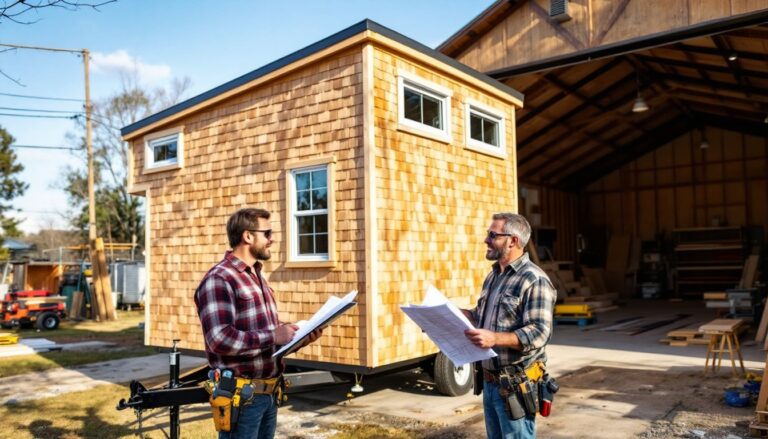
Site-built ADUs offer full design control and can adapt to odd lot shapes, slopes, or setback challenges. You’ll work with an architect or designer to create plans, then hire a general contractor (or act as your own). Total cost: $180-$400+ per square foot.
Site-built pros:
- Complete customization, ceiling heights, materials, window placement, built-ins
- Easier to match your main house’s style and finishes
- Can phase construction to match cash flow
Site-built cons:
- Longer timelines (6-12 months)
- Weather delays
- More opportunities for cost overruns and change orders
Hybrid approach: Some builders offer “semi-custom” prefab, where you choose from a catalog of floor plans and finishes, then they build and deliver. This splits the difference on cost and timeline.
If you’re handy and want to save money, site-built allows you to DIY finish work, drywall, paint, flooring, trim, while leaving structural and mechanical work to pros. Prefab units arrive finished, so there’s less room for sweat equity.
Many homeowners researching home organization tips find that designing a tiny ADU forces them to plan storage and function upfront, which eliminates the clutter creep common in larger homes.
Conclusion
An ADU tiny house is a serious investment, but it pays off in flexibility, property value, and potential income. Start by confirming your local zoning allows ADUs, then decide whether prefab speed or site-built customization fits your budget and timeline. Get permits in order early, hire licensed pros for mechanicals, and don’t skip the foundation, it’s not a trailer, it’s a permanent structure. Done right, your backyard ADU will serve your family for decades.