Table of Contents
ToggleA 400 square foot tiny house isn’t just downsizing, it’s right-sizing for people serious about mobility, lower overhead, and intentional living. At this square footage, the space is large enough to include full-height ceilings, a separated sleeping area, and a real kitchen, yet compact enough to potentially qualify as a towable dwelling in many jurisdictions. Whether building on a trailer, a permanent foundation, or a skid system, this size walks the line between backpacking-tent minimalism and actual comfort. The key is understanding that every square inch has a job to do.
Key Takeaways
- A 400 square foot tiny house offers the ideal balance between minimalism and comfort, accommodating full-height ceilings, separate sleeping areas, and real kitchens while remaining compact enough to qualify as a towable dwelling in many jurisdictions.
- Smart layout and storage solutions are essential; utilizing vertical storage, under-stair compartments, multi-function furniture, and strategic zoning can maximize functionality without sacrificing comfort or safety.
- Building costs for a 400 square foot tiny house range from $20,000 for DIY budget builds to over $100,000 for high-end custom homes, with foundation or trailer costs and soft costs like permits often being underestimated.
- Regulatory compliance is critical; always verify local IRC Appendix Q standards for ceiling heights, egress windows, and zoning classifications to avoid costly design changes or inspection failures.
- Design features like natural lighting on multiple walls, appropriate kitchen and bathroom fixtures, and quality insulation with proper ventilation are non-negotiable for creating a livable and durable 400 square foot tiny home.
Why 400 Square Feet Is the Sweet Spot for Tiny House Living
400 square feet offers enough room for distinct zones without tipping into the maintenance and cost territory of a traditional home. Most single adults or couples find this size provides adequate space for a full bathroom with a standard 60-inch tub or shower, a kitchen with full-size appliances (not just a cooktop and mini-fridge), and a living area that doesn’t double as a hallway.
From a regulatory standpoint, many municipalities define dwellings under 400 square feet differently than larger homes, sometimes exempting them from certain zoning restrictions if they’re classified as recreational vehicles or accessory dwelling units (ADUs). Always check local IRC (International Residential Code) Appendix Q standards, which outline minimum requirements for tiny houses, including ceiling heights (6’8″ in bathrooms and kitchens, 6’4″ in lofts) and egress window sizes.
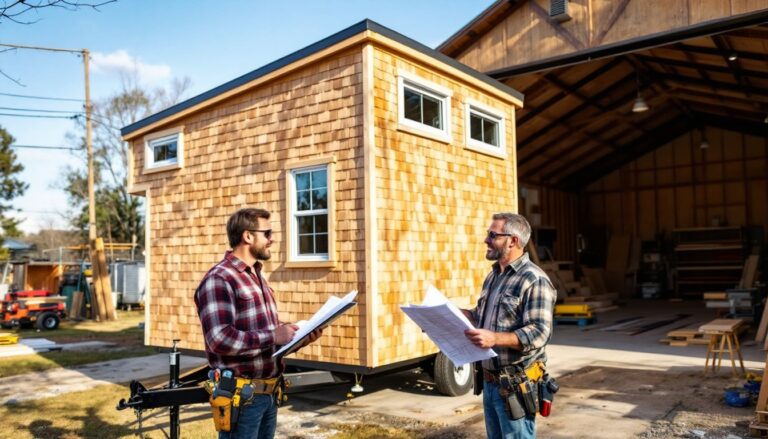
This square footage also keeps material costs reasonable. A typical build uses standard 2×4 or 2×6 wall framing, and you’re looking at around 50 to 60 sheets of ½-inch plywood or OSB sheathing for walls, floors, and roof decking, depending on your design. That’s manageable for a two-person crew over a few weekends.
Finally, HVAC becomes simpler. A single mini-split system rated for 9,000 to 12,000 BTUs can handle heating and cooling in most climates, eliminating the need for ductwork and cutting installation costs significantly compared to forced-air systems.
Layout and Floor Plan Options for 400 Square Foot Tiny Homes
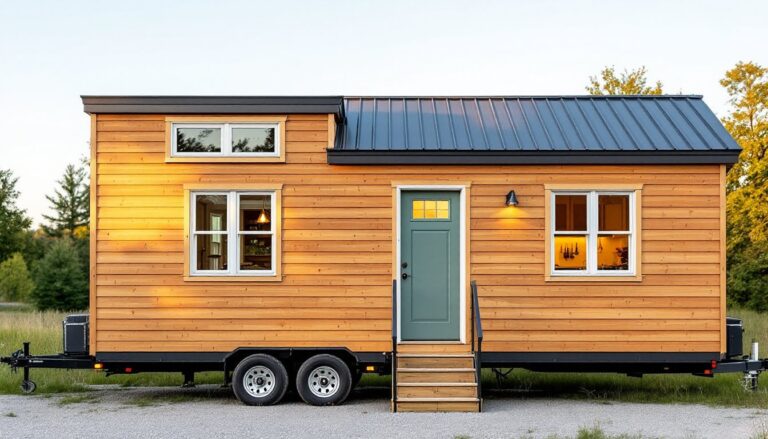
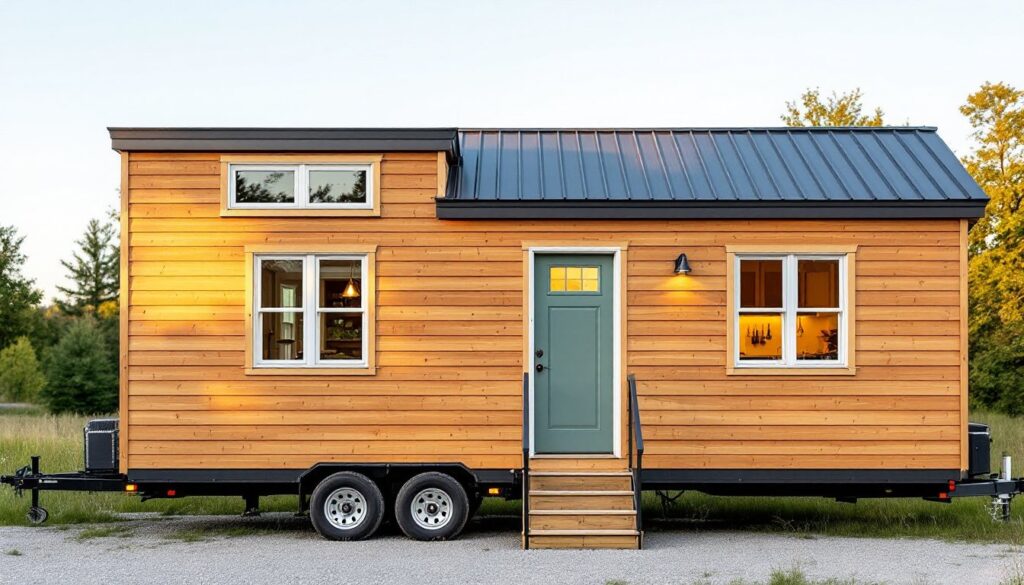
Floor plan decisions start with whether the home sits on a trailer or a foundation. Trailer-based builds typically max out at 8’6″ wide to stay street-legal without an oversized load permit, which constrains your layout to a narrow, elongated rectangle, usually around 8′ × 24′ or 8′ × 28′. Foundation or skid builds offer more flexibility, including square or L-shaped footprints.
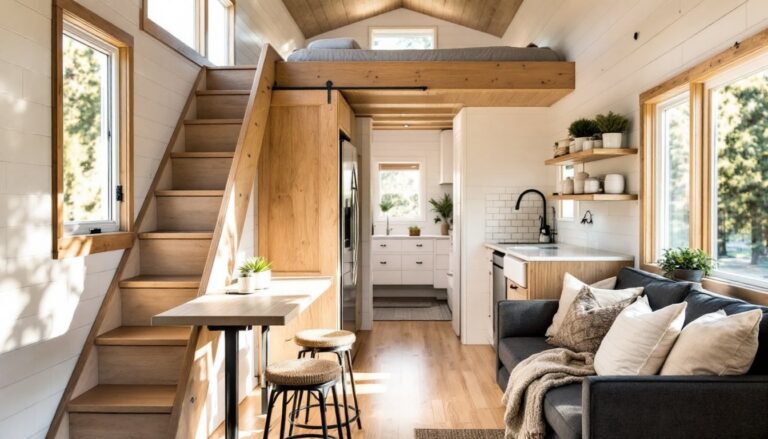
Most 400-square-foot plans incorporate a sleeping loft to free up main-floor real estate. Standard loft dimensions run 6′ to 8′ deep and span the width of the house. Use 2×6 or 2×8 joists on 16-inch centers to support the load, and install a permanent staircase instead of a ladder if space permits, stairs with integrated storage drawers (often called “tansus” after Japanese design) add function without sacrificing safety.
If a loft isn’t appealing, a ground-floor bedroom works but eats into your multipurpose space. A Murphy bed or sliding barn door can partition the sleeping area from the main room without permanent walls.
Many tiny homes inspired by designs found on platforms like Apartment Therapy showcase flexible layouts that adapt to changing needs without major renovations.
Open Concept vs. Divided Spaces
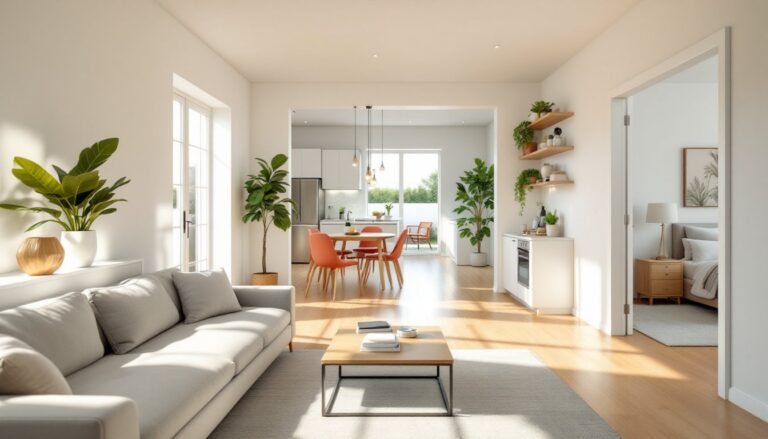
Open concept layouts maximize perceived space and natural light. The kitchen, dining, and living areas flow together without interior walls, which also simplifies framing and reduces material costs. But, sound travels easily, running water, cooking smells, and conversations all overlap. If two people share the space with different schedules, this can become a friction point.
Divided layouts use partial walls, sliding panels, or curtains to create zones. A half-wall (typically 42″ to 48″ high) between the kitchen and living area provides separation without blocking sightlines. Pocket doors or barn-style sliders on wall-mounted track hardware can close off a bedroom or bathroom when needed, then disappear when not in use. These require 1×4 or 1×6 backer boards installed horizontally between studs during framing to anchor the track securely.
Consider how you’ll route plumbing and electrical. Centralized plumbing (bathroom and kitchen sharing a wet wall) cuts costs and simplifies waste line runs, but it may dictate where those rooms sit in your layout.
Smart Storage Solutions to Maximize Every Inch
In a 400-square-foot home, storage isn’t an afterthought, it’s structural. Built-in cabinetry along walls, under stairs, and beneath seating provides more capacity than freestanding furniture, which often includes wasted negative space.
Start with toe-kick drawers under base cabinets. Standard cabinet toe kicks are 4″ tall: converting that dead space into shallow pull-out drawers adds 10 to 15 linear feet of storage for flat items like baking sheets, cutting boards, or cleaning supplies. Use ¾-inch plywood for drawer boxes and full-extension soft-close slides rated for at least 75 pounds.
Vertical storage is critical. Install shelving or cabinets to within 12 inches of the ceiling in kitchens and bathrooms. Use upper cabinets that extend to the ceiling rather than stopping at the standard 36″ above the counter. Yes, you’ll need a step stool for the top shelf, but that’s where you stash the serving platters and seasonal items.
Staircase storage is the gold standard for tiny homes. Each tread can conceal a drawer or lift-up compartment. If you’re building stairs to a loft, frame them as a series of boxes using 2×6 or 2×8 risers and ¾-inch cabinet-grade plywood for drawer fronts. Each step can hold 2 to 3 cubic feet.
Consider multi-function furniture. A dining table mounted to the wall on a folding bracket or hinged drop-leaf saves 8 to 10 square feet when not in use. Benches with lift-top seats provide seating and storage without taking up floor space. Creative solutions seen in projects on IKEA Hackers often show how affordable modular units can be transformed into highly functional custom storage.
Don’t overlook exterior storage. A weatherproof deck box or a small shed for tools, outdoor gear, and seasonal items keeps the interior from becoming a cluttered catch-all.
Essential Design Features for Functionality and Comfort
Natural light is non-negotiable in a small space. Install windows on at least two walls (preferably three) to create cross-ventilation and reduce the cave-like feeling. Egress windows in lofts must meet IRC minimums: 5.7 square feet of clear opening, with no dimension less than 24 inches, and a sill height no more than 44 inches above the loft floor. Casement or awning windows work well because they open fully and don’t take up interior space like double-hung units.
For layout efficiency, choose a 30-inch or 32-inch exterior door instead of the standard 36 inches. It’s easier to maneuver in tight spaces and frees up a few inches inside for a coat hook or narrow shelf. If building on a trailer, keep the door on the long side, not the gable end, to avoid excessive steps.
Kitchen and bath fixtures need to be full-function but space-conscious. A 24-inch range (available in propane, electric, or induction) fits better than a 30-inch model without sacrificing two burners and an oven. Look for apartment-size dishwashers (18 inches wide) or consider a countertop model if you’re solo or a couple.
Bathrooms often benefit from a corner shower (32″ × 32″ or 36″ × 36″) instead of a tub. Use a low-profile shower pan instead of a traditional mortar bed to save ceiling height below if you’re building over a loft. Install a 110 CFM or higher exhaust fan vented to the exterior to manage humidity, mold is a real risk in tightly insulated tiny homes.
For climate control, invest in spray foam insulation (closed-cell, R-6 to R-7 per inch) in walls and roof cavities if your budget allows. It air-seals as it insulates and minimizes thermal bridging through framing. If spray foam isn’t in the budget, Roxul or mineral wool batts (R-15 in 2×4 walls, R-23 in 2×6 walls) offer good performance and fire resistance. Always include a vapor barrier appropriate for your climate zone.
Electrical planning matters. Tiny homes can run on standard 120/240V service (often 100-amp panels are sufficient), but if you’re off-grid, you’ll need a solar array, battery bank, and inverter sized to your actual load. Hire a licensed electrician if you’re unfamiliar with NEC (National Electrical Code) requirements, DIY electrical work often fails inspection.
Cost Breakdown: Building vs. Buying a 400 Square Foot Tiny House
Building costs vary wildly based on finishes, foundation type, and whether you’re doing the labor yourself. Budget DIY builds using reclaimed materials and basic finishes can come in around $20,000 to $30,000. Mid-range builds with new materials, standard appliances, and some subcontracted work (plumbing, electrical) typically run $40,000 to $60,000. High-end custom builds with designer finishes, off-grid systems, and professional labor can exceed $80,000 to $100,000.
Material costs for a shell (framing, sheathing, roofing, windows, and exterior doors) generally run $8,000 to $15,000 depending on lumber prices. For reference, you’ll need around 1,200 to 1,500 board feet of framing lumber (2×4s, 2×6s, and dimensional lumber for joists and rafters), plus 40 to 50 sheets of ½-inch or ⅝-inch OSB or plywood.
Interior finishes add up fast. Budget $3,000 to $6,000 for drywall or tongue-and-groove paneling, paint or stain, and trim. Kitchens and bathrooms are the big-ticket items: a basic kitchen (cabinets, countertop, sink, faucet, range, and refrigerator) runs $4,000 to $8,000, while a bathroom (toilet, shower or tub, vanity, fixtures) costs $2,500 to $5,000.
If you’re buying a pre-built or turnkey tiny home, expect to pay $50,000 to $90,000 for a 400-square-foot unit, depending on the builder and customization level. Savings come from bulk material purchasing and experienced labor, but you lose the ability to control every detail and do sweat-equity work.
Foundation or trailer costs are often underestimated. A heavy-duty tandem-axle trailer rated for 10,000 to 14,000 pounds runs $4,500 to $7,000. A permanent foundation (pier and beam, slab, or crawl space) varies by region but typically costs $3,000 to $8,000 including site prep and materials.
Don’t skip the soft costs: permits and inspections can range from $500 to $2,000 depending on jurisdiction, and insurance for a tiny home often requires specialty coverage. Strategies on Real Simple often highlight the importance of budgeting for hidden costs that can derail a project if overlooked.
Conclusion
A 400-square-foot tiny house delivers a livable, functional space if designed with intention and built with attention to detail. It’s not about cramming a traditional home into a smaller footprint, it’s about rethinking how space is used, stored, and enjoyed. Whether you’re building, buying, or modifying, prioritize smart layout decisions, quality materials where they matter, and don’t skip the unglamorous stuff like insulation, ventilation, and proper framing. The result is a home that works hard and lives large.