Table of Contents
ToggleIf you’ve ever found yourself watching Tiny House Hunters at 10 PM on a Tuesday, wondering if you could realistically downsize to 200 square feet, you’re not alone. HGTV’s tiny house programming sparked a nationwide fascination with micro-living that went far beyond entertainment. These episodes didn’t just showcase cramped quarters, they challenged conventional ideas about space, storage, and what “home” really means. Whether you’re genuinely considering a tiny build or just hunting for clever storage hacks to apply in your regular-sized house, the show offers tangible takeaways that translate to real projects.
Key Takeaways
- HGTV Tiny House episodes revolutionized how people think about space by showcasing real tradeoffs in micro-living, proving that clever design solutions apply to homes of any size.
- Vertical space utilization, multi-function furniture, and shallow cabinets are practical storage techniques featured in tiny house episodes that homeowners can implement in standard homes.
- Memorable HGTV tiny house builds prioritize lifestyle needs first—like dedicated workspace or accessible bedrooms—demonstrating that successful design must match how residents actually use their homes.
- Simple DIY projects inspired by the show, such as staircase storage drawers, window seat benches, and built-in shelving, provide 30–40% more storage per square foot without major renovations.
- Tiny house design ideas like sliding barn doors, appliance garages, and Murphy beds showcase time-tested solutions that save floor space and reduce visual clutter in any home.
- HGTV tiny house episodes are accessible through Discovery+, Max, Amazon Prime Video, and YouTube, with builder channels offering real-world updates on how designs perform long-term.
What Is HGTV’s Tiny House Hunters and Why It Became a Cultural Phenomenon
Tiny House Hunters premiered in 2014 as a spin-off of the network’s flagship House Hunters series, but instead of suburban three-bedrooms, it followed buyers shopping for homes under 500 square feet. The format was familiar, tour three properties, weigh pros and cons, pick one, but the scale was radically different.
The show hit at the perfect cultural moment. Housing costs were climbing post-recession, minimalism was trending, and environmental consciousness was pushing people to reconsider consumption. Suddenly, a 180-square-foot house on wheels didn’t look like deprivation, it looked like freedom.
What made the show compelling wasn’t just the novelty. It was watching real people wrestle with hard tradeoffs: Do you need a full-size fridge or will a mini work? Can you live without a real oven? Where do winter coats go? These weren’t abstract design questions, they were the same space problems every homeowner faces, just amplified. The episodes functioned as a stress test for what’s actually essential in a home.
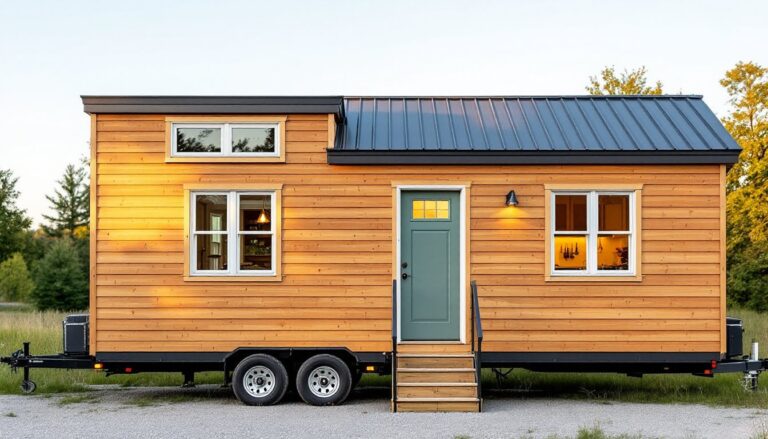
The format also showcased a range of builds: custom THOWs (tiny houses on wheels), converted shipping containers, park model RVs, and backyard ADUs (accessory dwelling units). That variety kept the show from feeling repetitive and gave viewers a practical education in alternative housing options, many of which don’t require the same permitting as traditional site-built homes (though zoning laws vary widely by jurisdiction).
Most Memorable HGTV Tiny House Episodes Worth Watching
Some episodes stand out, not because they’re the prettiest, but because they reveal something honest about tiny living or showcase genuinely clever builds.
One often-cited episode features a couple in Colorado who chose a custom 207-square-foot THOW with a ground-floor bedroom instead of a loft. That decision sacrificed ceiling height in the main living area but solved a real problem: climbing a ladder every night isn’t sustainable long-term, especially as you age or if mobility becomes an issue. It’s a reminder that tiny house design isn’t one-size-fits-all.
Another standout involved a musician in Nashville who needed dedicated workspace. The builder incorporated a fold-down desk with integrated cable management and a lofted storage area specifically for instrument cases. The lesson? If your lifestyle has non-negotiable needs (a workspace, a yoga area, a pottery wheel), you design around that first, not as an afterthought.
Then there’s the episode with a family of four attempting to live in under 400 square feet. It was uncomfortable to watch in parts, and honestly, it didn’t look sustainable. But that’s valuable too. The show didn’t always glorify tiny living, it showed when it doesn’t work, which is crucial context for anyone romanticizing the idea without considering how they actually use space daily.
The episodes featuring tiny house design ideas often highlighted builds with bump-outs, which add 12–18 inches in strategic spots (usually for a dining nook or desk). Structurally, they’re cantilevered extensions supported by the floor joists and don’t touch the ground, legal on trailers, where total width still stays within the 8.5-foot road limit.
Real Lessons from HGTV Tiny House Episodes: What Homeowners Actually Learn
The show’s biggest contribution isn’t inspiring people to go tiny, it’s teaching spatial problem-solving that applies at any scale.
First: vertical space is underused in most homes. Tiny houses are forced to go up, with storage lofts, hanging pot racks, and wall-mounted everything. In a conventional home, that translates to adding shelving above doorways, using the top 12 inches of closets, or installing a ceiling-mounted rack in the garage.
Second: multi-function furniture isn’t gimmicky when done right. Forget the Transformers-style beds that fold into walls (those break). The useful stuff is simpler: a bench with lift-up storage, a dining table with drawers on both sides, or a staircase where each tread is a pull-out drawer. These are buildable DIY projects using 3/4-inch plywood, piano hinges, and basic pocket-hole joinery.
Third: you don’t need a full-depth cabinet everywhere. Tiny houses often use 8- or 10-inch-deep cabinets in hallways or above toilets, perfect for toiletries, spices, or office supplies. In a regular house, this means you can add storage in spaces you’d normally leave blank, like the 14-inch gap between a door frame and a corner.
Design and Storage Solutions Featured in Popular Episodes
Certain design moves show up repeatedly because they work:
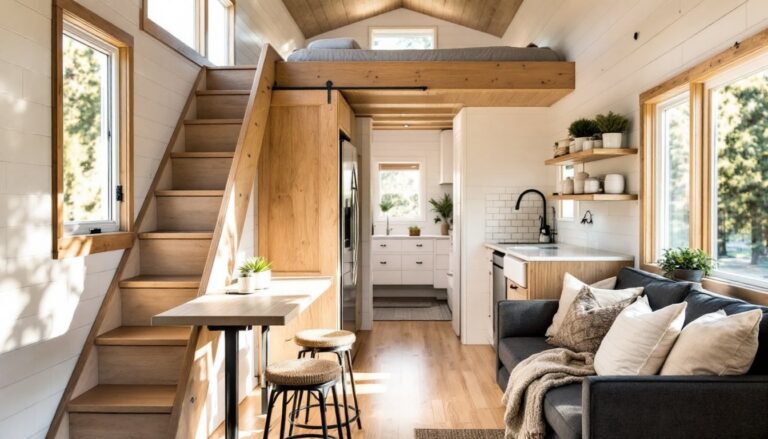
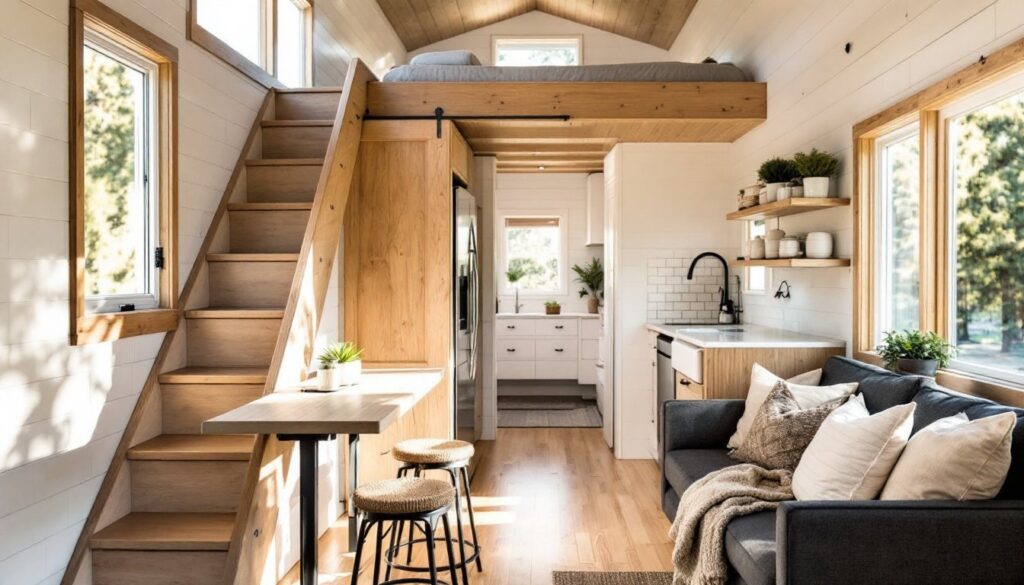
- Staircase storage: Rather than a ladder, several builds use alternating-tread stairs (also called ship stairs) with built-in drawers. These meet IRC code for lofts when built to a 7.5-inch rise and 10-inch run, though local codes vary. Each tread drawer can hold shoes, tools, or pantry goods.
- Sliding barn doors: They save the swing clearance of a standard door (about 9 square feet per door). Use ball-bearing roller hardware rated for the door weight, cheap kits sag and derail.
- Appliance garages: Countertop appliances (toaster, coffee maker, stand mixer) live in a cabinet with a tambour door or lift-up panel. Keeps counters clear without the hassle of daily storage.
- Murphy beds done right: The reliable versions are side-mount, spring-assisted units anchored into wall studs with lag bolts, not drywall anchors. Expect to pay $1,500–3,000 for a kit that won’t pinch fingers or collapse.
Several episodes featured builders who incorporated ideas from DIY furniture builds, especially platform beds with drawers and bench seating with hidden storage, both achievable weekend projects with a miter saw, drill, and patience.
How to Apply HGTV Tiny House Ideas to Your Own Home
You don’t need to go tiny to benefit from tiny house thinking. Here’s how to translate what you see on screen into projects that work in a standard house.
Start with a space audit. Pick one room and remove everything. Put back only what you’ve used in the last three months. What’s left is your real storage need, build or buy solutions for that, not for theoretical future use.
Install wall-mounted shelving where you have dead space. The area above a desk, beside a window, or in a laundry room hallway is often blank. A simple 16-inch-deep shelf on metal brackets (anchored into studs with 3-inch screws) adds usable storage without eating floor space. Use 1×12 pine, poplar, or pre-finished melamine depending on your budget and finish preference.
Replace bulky furniture with built-ins. A store-bought dresser takes up 18–24 inches of floor depth. A built-in closet system with drawers takes 12–14 inches and goes floor to ceiling. You lose some flexibility in rearranging, but you gain 30–40% more storage per square foot.
Use pocket doors or barn doors in tight spaces. A standard interior door needs a 3-foot radius to swing. If that’s blocking furniture placement or creating awkward traffic flow, swap it. Pocket door frames require opening the wall and adding a header (since you’re removing a stud), so it’s a moderate-level remodel. Barn doors are surface-mounted and much easier, just make sure your wall can handle the weight (mount the track into studs or use blocking).
Build a window seat with storage. If you have a bay window or a decent-length wall under a window, frame a bench using 2x4s for the base and a 3/4-inch plywood top. Hinge the top or add pull-out drawers underneath. Add a 2-inch foam cushion cut to size. It’s a beginner-friendly project that adds seating and storage.
Where to Watch HGTV Tiny House Episodes in 2026
As of 2026, Tiny House Hunters and related shows like Tiny House, Big Living are available on several platforms, though availability shifts as licensing deals change.
The easiest access is through the HGTV streaming hub, which offers on-demand episodes with a cable login or via Discovery+ (the parent network’s streaming service). Discovery+ carries the full back catalog, including episodes no longer in cable rotation.
Max (formerly HBO Max) also hosts HGTV content as part of its broader Discovery merger. You’ll find curated collections and some full seasons there, though the library rotates.
Free options are limited but exist. Pluto TV occasionally streams HGTV content on its home improvement channels, though you can’t pick specific episodes. Some episodes are available for purchase on Amazon Prime Video or Apple TV, typically $1.99–2.99 per episode or $9.99–14.99 per season.
If you’re hunting for specific builds or design ideas rather than full episodes, YouTube has a robust collection of tiny house tours, many from the actual builders featured on the show, filmed after the episodes aired. These often include updates on how the homes held up after a year or two of use, which is more useful than the original episode.
Conclusion
HGTV’s tiny house episodes did more than entertain, they shifted how a generation thinks about space, stuff, and what’s actually necessary in a home. You don’t have to embrace 200 square feet to benefit from the lessons. The real value is in the problem-solving: designing for how you actually live, not how you think you should. Whether that means adding a wall-mounted fold-down desk, rethinking your closet layout, or just finally admitting you don’t need that bread maker, the show’s legacy is in making us all a little more intentional about the spaces we build and occupy.