Table of Contents
ToggleSpotting tiny bugs crawling across your countertop or swarming near a window isn’t just annoying, it’s a sign something in your home is attracting them. Whether they’re clustering around drains, burrowing into fabrics, or hovering near fruit bowls, these pests didn’t show up by accident. Most household bugs are drawn by moisture, food residue, or entry points you didn’t know existed. The good news? You don’t need an exterminator for every infestation. With the right identification and a few targeted DIY methods, you can eliminate most tiny bug problems and keep them from coming back.
Key Takeaways
- Identify common types of tiny bugs in your house—including carpet beetles, fruit flies, drain flies, and bed bugs—to determine the most effective elimination method for your specific pest problem.
- Remove moisture sources and food residue that attract tiny bugs, such as fixing leaky pipes, cleaning drains with enzymatic cleaners, and storing produce in sealed containers or the refrigerator.
- Use targeted DIY treatments like apple cider vinegar traps for fruit flies, diatomaceous earth for carpet beetles, and soil drying techniques for fungus gnats before considering professional pest control.
- Seal entry points with caulk and weatherstripping, maintain regular vacuuming and decluttering, and inspect secondhand furniture to prevent tiny bugs from returning to your home.
- Early intervention is critical—spotting and addressing even a few tiny bugs immediately prevents small infestations from becoming widespread problems that require professional heat treatment.
Common Types of Tiny Bugs Found in Homes
Before you can fix the problem, you need to know what you’re dealing with. Most tiny household bugs fall into a few common categories, each with distinct behaviors and preferred habitats.
Carpet Beetles and Bed Bugs
Carpet beetles are small, oval-shaped insects about 1/16 to 1/8 inch long. Adult beetles are often black with mottled brown, white, or yellow scales. Their larvae, fuzzy, carrot-shaped grubs, are the real troublemakers. They feed on natural fibers like wool, silk, feathers, and pet hair, leaving irregular holes in clothing, upholstery, and carpets. You’ll often find them near baseboards, in closets, or under furniture where lint and hair accumulate.
Bed bugs are reddish-brown, flat, and about 1/4 inch long (roughly the size of an apple seed). Unlike carpet beetles, they feed on blood, yours. They hide in mattress seams, box springs, bed frames, and nearby cracks during the day, emerging at night to feed. If you wake up with itchy, linear bite marks and notice dark spots (fecal stains) on bedding, you likely have bed bugs. This is a tough DIY problem: severe infestations usually require professional heat treatment or pesticide application.
Fruit Flies, Gnats, and Drain Flies
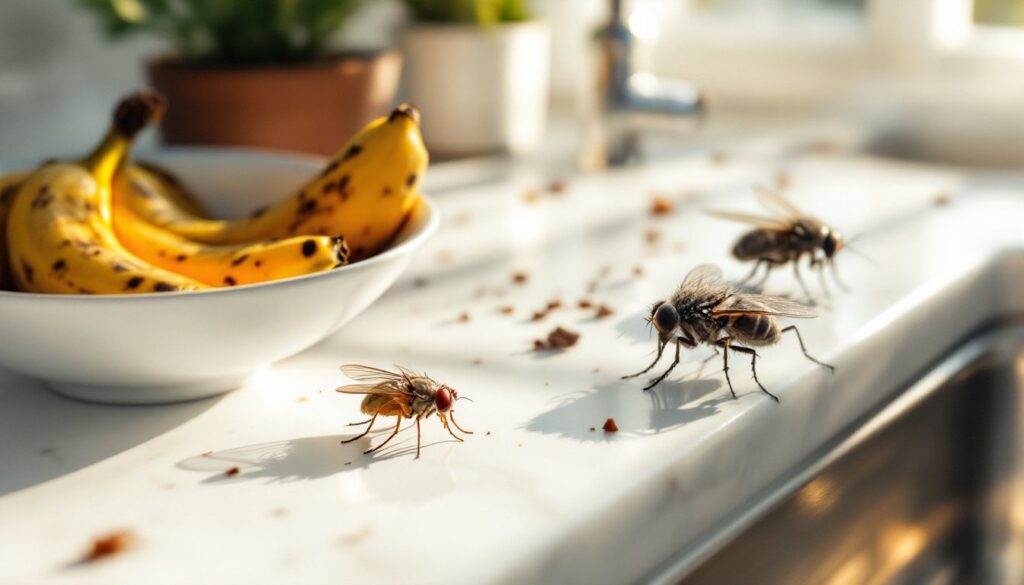
Fruit flies are tan or brown with red eyes, measuring about 1/8 inch. They’re drawn to overripe fruit, fermenting liquids, and sticky residue on counters or in trash cans. They breed fast, females lay up to 500 eggs on moist, decaying organic matter. Even a forgotten banana peel or spilled juice can trigger an infestation within days.
Fungus gnats resemble tiny mosquitoes (1/8 inch, dark gray or black). They swarm around houseplants because their larvae feed on organic matter and fungi in moist potting soil. Overwatering is the primary culprit. Adults don’t bite, but they’re a nuisance and a sign your plants are sitting in too much moisture.
Drain flies (also called moth flies) are fuzzy, gray, and about 1/8 inch long with large, fuzzy wings. They breed in the organic slime that builds up inside drain pipes, garbage disposals, and sewer lines. You’ll see them resting on bathroom or kitchen walls near sinks. Unlike fruit flies, they’re weak fliers and tend to hop short distances.
Where These Tiny Bugs Hide and Why They’re in Your Home
Tiny bugs aren’t invading randomly, they’re exploiting weak points in your home’s defenses. Understanding their hiding spots helps you target treatment more effectively.
Moisture is the biggest draw. Drain flies and fungus gnats thrive in damp environments. Check under sinks, around leaky pipes, in basement corners, and near HVAC condensate lines. Even a slow drip inside a wall cavity can create a breeding ground. Fixing leaks and improving ventilation in bathrooms and crawl spaces removes their habitat.
Food sources attract fruit flies and pantry pests. Overripe produce, uncovered trash, sticky spills behind appliances, and recycling bins with unwashed containers all provide feeding and breeding sites. Pet food left out overnight is another common culprit.
Entry points include gaps around windows, doors, foundation cracks, torn screens, and utility penetrations. Carpet beetles and bed bugs often hitchhike indoors on used furniture, luggage, or clothing. Bed bugs are especially common in multi-unit housing where they can migrate through shared walls.
Natural fibers and clutter draw carpet beetles. They’re often found in rarely disturbed areas: closets, storage boxes, and under furniture. Pet hair, lint, and dead insects provide food for larvae. Decluttering and regular vacuuming disrupt their life cycle.
Many homeowners follow cleaning tips to maintain pest-free spaces, but prevention starts with eliminating moisture and food sources before bugs even appear.
DIY Methods to Get Rid of Tiny Bugs
Once you’ve identified the pest, you can choose the right elimination method. Most infestations respond to a combination of sanitation, traps, and targeted treatment.
For fruit flies:
- Remove all attractants. Toss overripe fruit, clean drains with a stiff brush and enzymatic drain cleaner (not just bleach, it doesn’t break down organic matter), and wipe down counters with diluted vinegar.
- Set DIY traps. Fill a small jar with 1/4 cup apple cider vinegar, a drop of dish soap, and plastic wrap secured with a rubber band. Poke small holes in the wrap. Flies enter but can’t escape. Replace every few days.
- Empty and clean trash cans and recycling bins weekly with hot, soapy water.
For fungus gnats:
- Let soil dry out between waterings. The top 1-2 inches should be dry to the touch before you water again.
- Apply a 1/2-inch layer of horticultural sand or fine gravel on top of the soil. This creates a barrier that prevents adults from laying eggs.
- Use yellow sticky traps near plants to catch adults. Replace weekly until you see no new gnats.
- For severe infestations, drench soil with Bacillus thuringiensis israelensis (Bti), a biological larvicide safe for plants and pets. Follow label directions.
For drain flies:
- Identify the breeding drain. Pour a cup of water down each drain at night, then place a piece of clear tape (sticky side down) over the drain opening. Check in the morning, trapped flies confirm the source.
- Clean the drain mechanically. Use a stiff drain brush to scrub the interior walls (a simple wire brush on a flexible rod works well). Follow with boiling water.
- Apply an enzymatic drain cleaner labeled for organic buildup. Repeat every few days for two weeks.
- If flies persist, the issue may be in a floor drain, sump pit, or septic line. That’s a job for a plumber.
For carpet beetles:
- Vacuum thoroughly, focusing on baseboards, under furniture, closet floors, and upholstered seams. Use the crevice tool in corners. Dispose of the vacuum bag or empty the canister outside immediately.
- Wash or dry-clean infested fabrics. Heat kills all life stages, launder in hot water (at least 120°F) and dry on high heat for 30 minutes.
- Freeze items that can’t be washed (stuffed animals, delicate textiles). Seal in plastic bags and freeze for 72 hours at 0°F or below.
- Apply diatomaceous earth (DE) (food-grade) along baseboards and in closets. DE is a fine powder that damages insect exoskeletons, causing dehydration. Wear a dust mask when applying, DE is non-toxic but irritates lungs. Leave for a few days, then vacuum.
- For persistent infestations, use a residual insecticide labeled for carpet beetles (look for active ingredients like permethrin or deltamethrin). Apply according to label directions, focusing on cracks, crevices, and hidden areas. Keep pets and children away until it dries.
For bed bugs:
Bed bugs require aggressive treatment, and DIY success is limited. If you catch them early (a few bugs, no widespread infestation), try this:
- Encase mattresses and box springs in zippered, bed-bug-proof covers. This traps bugs inside and prevents new ones from entering.
- Wash all bedding, curtains, and clothing in hot water (at least 120°F) and dry on high heat for 30+ minutes.
- Vacuum all cracks in bed frames, baseboards, and furniture. Dispose of the vacuum contents outside immediately.
- Apply diatomaceous earth around bed legs and along baseboards (same precautions as above).
- Use interceptor traps under bed legs to monitor and trap bugs.
If you’re still seeing bugs after two weeks, or if the infestation is widespread, call a licensed pest control professional. Heat treatment (raising room temperature to 120°F+ for several hours) is the most effective solution, but it requires specialized equipment.
Safety note: Always wear gloves, safety goggles, and a dust mask when applying powders or pesticides. Work in a well-ventilated area. Keep children and pets away from treated areas until products dry or settle.
How to Prevent Tiny Bugs from Returning
Elimination is only half the job. Without prevention, you’ll be fighting the same pests again in a few months.
Seal entry points. Walk the perimeter of your home and check for gaps. Use silicone caulk to seal cracks around windows, doors, and foundation. Install or repair weatherstripping on doors (a simple door sweep blocks a surprising number of pests). Repair torn window screens, even a small tear is an open invitation.
Control moisture. Fix leaky faucets, pipes, and HVAC lines. Run exhaust fans during and after showers to reduce humidity. In basements or crawl spaces, consider a dehumidifier to keep relative humidity below 50%. Clean gutters and downspouts to prevent water from pooling near the foundation.
Store food properly. Keep produce in the refrigerator or in sealed containers on the counter. Don’t leave fruit out to ripen if you’ve had fruit fly issues. Store pantry goods (flour, sugar, cereal) in airtight containers, this also prevents pantry moths and weevils. Take out trash daily and use bins with tight-fitting lids.
Vacuum and declutter regularly. Vacuum rugs, upholstery, and under furniture at least weekly. This removes food sources (crumbs, lint, pet hair) and disrupts pest life cycles. Reduce clutter in closets and storage areas, fewer hiding spots mean fewer bugs. Following expert home organization tips can help you keep spaces tidy and less attractive to pests.
Inspect secondhand items. Before bringing used furniture, clothing, or luggage indoors, inspect seams, crevices, and folds for bugs or eggs. Bed bugs are notorious hitchhikers. Wash or heat-treat items before storing them.
Maintain drains. Pour boiling water down infrequently used drains (basement floor drains, guest bathroom sinks) once a month to prevent organic buildup. Use enzymatic cleaners periodically in kitchen and bathroom drains.
Adjust plant care. Water houseplants only when the top inch of soil is dry. Use pots with drainage holes and well-draining potting mix. Avoid letting water sit in saucers. Detailed houseplant care guides can help you avoid overwatering and the fungus gnat infestations that follow.
Monitor and act fast. If you spot a few bugs, don’t wait to see if they multiply. Set traps, clean the area, and identify the source immediately. Early intervention prevents a small problem from becoming a major infestation.
Conclusion
Tiny bugs in your home aren’t a reflection of poor housekeeping, they’re opportunists looking for food, moisture, and shelter. By identifying the pest, targeting its habitat, and following through with prevention, you can reclaim your space without calling in professionals for every issue. Stay proactive, keep moisture and food sources in check, and seal up entry points. When in doubt, act fast, small infestations are always easier to handle than large ones.