Table of Contents
ToggleA 1 bedroom tiny house isn’t just about downsizing, it’s about designing a space that works harder for you. With housing costs climbing and more people rethinking what “home” really means, the single-bedroom tiny house has become a practical option for solo dwellers, couples, and even remote workers who want freedom from a mortgage. But building or buying one requires more than just good intentions. You’ll need to understand structural requirements, make smart layout decisions, and budget realistically. This guide walks through what makes a 1 bedroom tiny house functional, what it actually costs, and how to design one that doesn’t feel like living in a closet.
Key Takeaways
- A 1 bedroom tiny house between 100–400 square feet offers financial benefits, with construction costs ranging from $30,000–$80,000 compared to six figures for traditional homes.
- Code compliance is essential: ensure your 1 bedroom tiny house includes a full bathroom, climate control, egress windows, and meets IRC standards for ceiling height (6’8″ minimum over 50% of floor area).
- Built-in storage solutions like under-bed drawers, wall-mounted fold-down desks, Murphy beds, and sliding barn doors maximize functionality without sacrificing space or style.
- Ductless mini-split systems (9,000–12,000 BTU) paired with closed-cell spray foam insulation (R-6 to R-7 per inch) provide energy-efficient climate control ideal for tiny house living.
- Financing requires specialized options such as RV loans, personal loans, or credit union programs, as conventional lenders typically avoid tiny house mortgages.
- Efficient floor plans should separate the bedroom from the main living area using galley-style, L-shaped, or open-plan designs, with prioritized features like continuous kitchen countertop space and 32-inch neo-angle showers.
What Is a 1 Bedroom Tiny House?
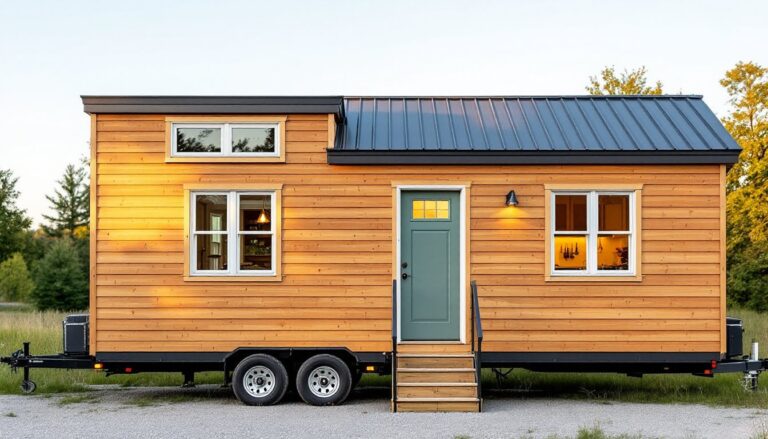
A 1 bedroom tiny house is typically a dwelling between 100 and 400 square feet that includes a separate, dedicated sleeping area rather than a loft or convertible space. Unlike studio-style tiny homes, the bedroom is enclosed, usually behind a door or partition, which offers privacy and better separation between living and sleeping zones.
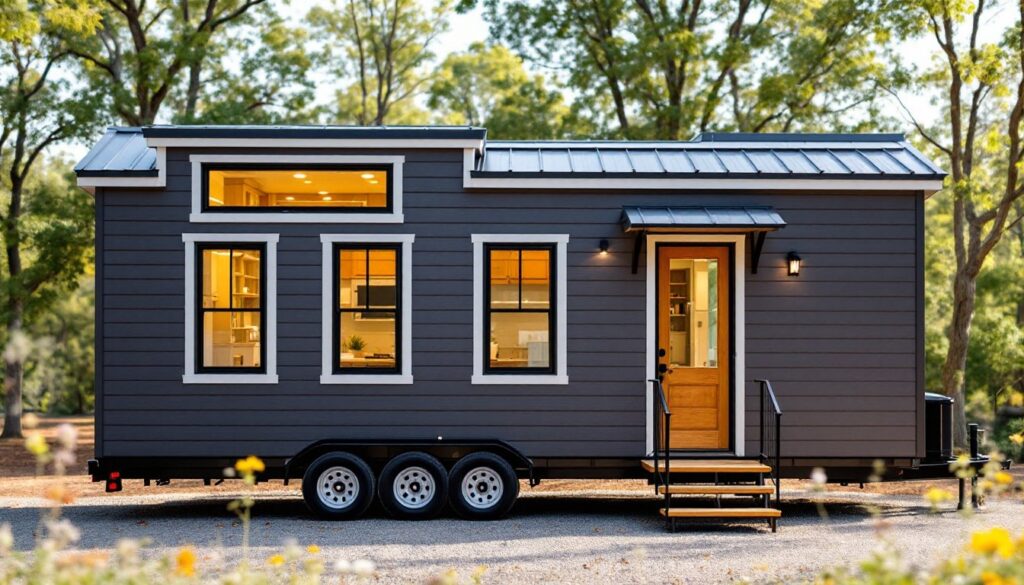
Most are built on one of three foundations: a trailer chassis (for mobility), a permanent foundation (for compliance with local zoning), or skids (for semi-permanent placement). If it’s on wheels, it’s often classified as a recreational vehicle (RV) under Department of Transportation standards, which affects where you can legally park it. If it’s on a foundation, it may be subject to the International Residential Code (IRC), Appendix Q, which sets minimum standards for tiny houses under 400 square feet.
The bedroom itself usually ranges from 60 to 100 square feet, just enough for a queen-size bed (60″ x 80″) and minimal furniture. Ceiling height in the bedroom should meet code minimums: 6 feet 8 inches over at least 50% of the floor area, per IRC standards. That’s tight but livable.
What separates a 1 bedroom tiny house from a camper or shed conversion is code compliance and livability. It should include a full bathroom, a functional kitchen, climate control, and egress windows that meet fire safety requirements. If you’re planning to finance, insure, or legally occupy the structure year-round, those details matter.
Benefits of Choosing a 1 Bedroom Tiny House
The financial upside is obvious: less square footage means lower material costs, reduced utility bills, and often a smaller or nonexistent mortgage. A typical 1 bedroom tiny house costs between $30,000 and $80,000 to build (more on that later), compared to six figures for a traditional home. Property taxes and insurance premiums drop accordingly.
Maintenance becomes manageable. You’re not repainting 2,000 square feet of siding or replacing a 30-year architectural shingle roof that costs $15,000. A standing seam metal roof on a tiny house might run $3,000 to $5,000 and last 40+ years with zero maintenance. Siding repairs, gutter cleaning, HVAC filter changes, all scale down.
For those chasing flexibility, a trailer-mounted tiny house offers mobility without selling property. You’re not locked into a zip code or a 30-year note. That appeals to remote workers, retirees exploring different climates, or anyone who wants housing that adapts to life changes rather than the other way around.
Environmentally, smaller spaces use fewer resources. Heating and cooling a 300-square-foot interior with a mini-split heat pump draws a fraction of the energy a conventional HVAC system demands. Less space also means less consumption overall, there’s simply nowhere to put unnecessary stuff, which naturally enforces decluttering habits and intentional living.
Finally, zoning laws are slowly catching up. Some municipalities now allow accessory dwelling units (ADUs) on existing lots, and a 1 bedroom tiny house can qualify. That opens the door to backyard rentals, in-law suites, or guest houses that generate income or add property value.
Essential Design Features for Maximum Functionality
Every square inch has to justify itself. Start with ceiling height. Standard stick-framed walls are built with 2×4 studs on 16″ centers, giving you about 8 feet of interior height after drywall and flooring. If you’re building on a trailer, account for the deck height, usually 20″ to 30″, which eats into your total before you hit the 13’6″ road-legal limit.
Windows aren’t optional. IRC-compliant bedrooms require an egress window with a minimum opening of 5.7 square feet, a sill height no more than 44 inches from the floor, and minimum dimensions of 20″ wide by 24″ tall. That’s a safety issue, not a style choice. Consider casement or awning windows for better ventilation per square foot, they open fully, unlike sliders.
For climate control, a ductless mini-split is the go-to. Units rated for small spaces (9,000 to 12,000 BTU) handle heating and cooling without ductwork. Pair that with spray foam insulation (closed-cell, R-6 to R-7 per inch) in walls and ceiling to keep energy loss minimal. Don’t skip a vapor barrier, tiny houses are prone to condensation issues because of limited air volume.
Electrical should be planned for real use. A 1 bedroom tiny house typically runs on a 100-amp service panel if on a foundation, or a 50-amp RV connection if mobile. Include at least two 20-amp circuits for kitchen appliances (microwave, induction cooktop, refrigerator), a dedicated circuit for a mini-split, and GFCI-protected outlets in the kitchen and bath per National Electrical Code (NEC).
Plumbing gets tricky in cold climates. If the house is mobile, use PEX tubing (cross-linked polyethylene) instead of copper or CPVC, it’s flexible, freeze-resistant, and easier to route. Install a tankless water heater (electric or propane) to save space. For waste, you’ll need either a connection to municipal sewer, a septic system, or a composting toilet if off-grid.
Smart Storage Solutions That Don’t Compromise Style
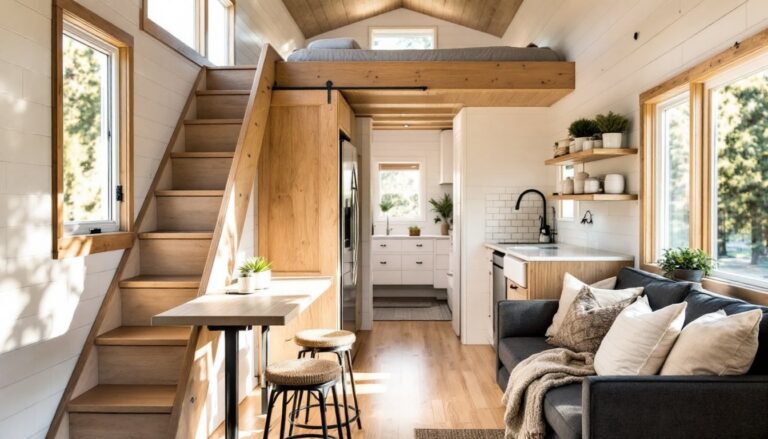
Built-ins are non-negotiable. Think under-bed drawers on full-extension slides, wall-mounted fold-down desks, and overhead cabinets that go all the way to the ceiling, no wasted space above. Use toe-kick drawers under base cabinets in the kitchen for flat items like baking sheets or cutting boards.
In the bedroom, a Murphy bed or platform bed with hydraulic lift storage gives you access to 10+ cubic feet of hidden space. For closets, skip the traditional swing door and use a sliding barn door or curtain track to save the door swing clearance, about 9 square feet you can’t furnish otherwise.
Many small space strategies focus on vertical storage: pegboards for tools or kitchen utensils, magnetic knife strips, ceiling-mounted pot racks, and floating shelves made from ¾-inch plywood or solid wood. Avoid particleboard: it sags under load and doesn’t hold screws well in a structure that might be moving.
Staircase storage is a classic tiny house move if you’re building a loft (even a small one for storage above the bedroom). Each tread can be a drawer. Use piano hinges and soft-close slides to keep them from rattling.
Cost Breakdown: Building vs. Buying a 1 Bedroom Tiny House
Building from scratch typically costs $150 to $300 per square foot, depending on finishes and whether you’re doing the labor. A 300-square-foot build might run:
- Trailer or foundation: $3,000–$7,000 (trailer) or $5,000–$12,000 (permanent foundation)
- Framing lumber (2x4s, 2x6s, engineered beams): $3,000–$6,000
- Exterior sheathing and siding (OSB, LP SmartSide, or metal): $2,500–$5,000
- Roofing (metal or architectural shingles): $2,000–$4,000
- Windows and exterior door: $2,000–$4,500
- Insulation and vapor barrier: $1,500–$3,000
- Electrical (panel, wiring, fixtures): $2,500–$5,000
- Plumbing (PEX, fixtures, water heater): $2,000–$4,000
- Interior finishes (drywall or tongue-and-groove, paint, flooring): $4,000–$8,000
- Kitchen and bath (cabinets, countertops, appliances, shower pan, toilet, vanity): $5,000–$10,000
- HVAC (mini-split): $1,500–$3,000
Total: $29,000 to $71,500 for a DIY build, assuming you’re doing most of the work yourself. Hire out framing, electrical, and plumbing, and you’re closer to $60,000 to $90,000.
Buying a prefab or turnkey model ranges from $50,000 to $100,000+, depending on the builder and customization. You’re paying for labor, design, and often a warranty. Prefab tiny house companies typically offer shell builds (framed, insulated, and weatherproofed but unfinished inside) for less, around $30,000 to $50,000, which you finish yourself.
Used tiny houses on the secondary market can be found for $25,000 to $60,000, but inspect carefully. Check for water damage around windows, roof seams, and under sinks. Look at the trailer frame for rust or stress cracks in the welds. Confirm that wiring and plumbing meet code if you plan to get a certificate of occupancy.
Financing is harder for tiny houses, especially on wheels. Most conventional lenders won’t touch them. Look into RV loans, personal loans, or builder loans if constructing on a foundation. Credit unions and specialized tiny house lenders exist but expect higher interest rates (6%–10%+) and shorter terms (10–15 years max). If building as an ADU on existing property, a home equity line of credit (HELOC) might be an option.
Layout Ideas and Floor Plans That Work
The most efficient 1 bedroom tiny house layouts separate the bedroom from the main living area without sacrificing flow. Avoid long, narrow hallways, they waste space and feel cramped. Instead, use the bedroom door as a natural divider.
Galley-style floor plans put the kitchen and bathroom along one wall, with the living area and bedroom at opposite ends. This works well in trailers where plumbing can be centralized. A typical breakdown for a 24-foot trailer (about 192 square feet inside) might be:
- Kitchen: 30 square feet (8-foot galley with base cabinets, small fridge, two-burner cooktop)
- Bathroom: 25 square feet (corner shower, wall-hung toilet, pedestal sink)
- Living area: 60 square feet (loveseat or bench seating, fold-down table)
- Bedroom: 75 square feet (queen bed, one nightstand, small closet)
L-shaped layouts angle the bedroom off the main room. This creates a visual separation without a full hallway and often allows for a larger bed or a small closet. You lose a bit of wall space for windows but gain privacy.
Open-plan designs skip walls between living and sleeping zones entirely, using a bookshelf, half-wall, or curtain track as a divider. This maximizes light and airflow but sacrifices acoustic privacy, fine for solo living, less so for couples with different schedules.
For kitchen layouts in tight quarters, prioritize countertop space over cabinet quantity. A 30-inch run of continuous counter is more useful than a dozen small, disconnected surfaces. Consider an induction cooktop instead of gas, no venting required, safer in small spaces, and more energy-efficient. Use a 24-inch apartment-size refrigerator or an under-counter fridge/freezer combo to save vertical space.
Bathrooms should be at least 3 feet wide for comfortable use. A 32-inch neo-angle shower fits tighter than a standard tub and uses less water. Wall-hung toilets free up floor space for cleaning and make the room feel bigger. Skip the vanity cabinet if you’re tight on space, a wall-mounted sink with a medicine cabinet above works fine.
Conclusion
A 1 bedroom tiny house is a real build, not a daydream with Pinterest boards. It requires planning, code knowledge, and realistic budgeting. But done right, it delivers a home that’s affordable, efficient, and designed around what actually matters to you, without the square footage you’ll never use. Whether you’re building on a trailer or pouring a slab, the principles stay the same: maximize function, respect the structure, and don’t skip the details that keep it legal and livable.